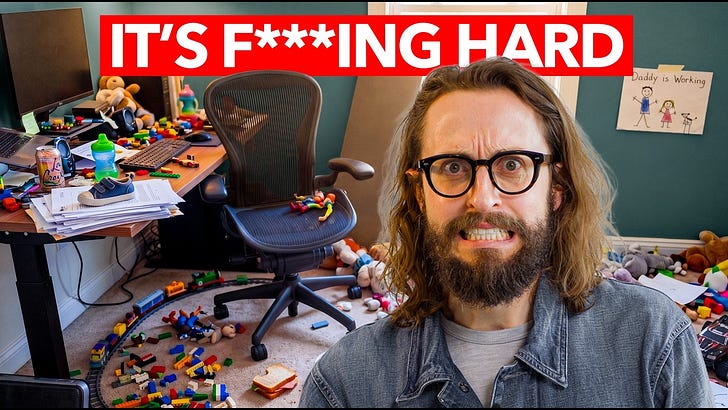

This is the written version of this week's episode. As always, the podcast is the full, unedited, occasionally unhinged version — this is the good bits, organised. Listen on [Spotify / Apple / YouTube].
Hey,
So this is a crazy one:
Between roughly 2018 and 2022, at the exact moment AJ&Smart hit its peak revenue (around $6 million revenue, with a 47% profit margin), I wanted to give the company away.
Not sell it. Give it. To anyone who’d take it. Or shut it down. I was talking to people about both options. My co-founder wanted to be bought out, and honestly, part of me wanted to be bought out too. There is a very real alternate timeline where I am not running this company today.
If you’ve never owned a business, that sentence sounds insane. Peak revenue! Great margins! What’s the problem?
If you have owned a business, you might already know exactly what the problem was. So let me give you the short version first, and then the whole story.
The nuggets (if you only read one section, read this one)
The “held hostage in your own company” feeling is real, common, and almost nobody talks about it publicly. I now speak to founders constantly who describe the same thing: you walk into your own office and feel like you’re not wanted there. Like it’s not your company anymore. Like you’d have to ask permission to change anything.
It’s almost never a revenue problem. It’s a hiring problem. Not “hiring is bad.” Hiring badly, for years, in ways that compound.
Perks don’t buy goodwill. They buy expectations. We had a chef on Fridays, yoga twice a week, retreats, a basically unlimited tech budget. The result was not gratitude. It was “why don’t we have a chef every day?”
“Hire when you need someone” is a spending instruction. The second I removed myself from hiring and told the team to hire whenever they felt they needed to, people hired the moment they felt slightly busy. At our peak of dysfunction, we had four employees managing one small office. My friend Sam Ovens was running a $12M company with nine people and a cleaner who came once a week.
The way out was not “small team good, big team bad.” I want to be really clear on this, because it’s the lazy takeaway. Hiring is one of the only real forms of leverage a business owner has. The lesson is that there’s a right size and a right culture for you, and you probably can’t know it until you get it wrong.
If you feel this way right now: it’s fixable. But it takes years, not quarters. And almost everyone I know who took the eject seat and sold tells me the same thing today: I wish I hadn’t done it.
Okay. The story. (You can also just watch the video if you don’t feel like reading)
My own personal utopia (and how I wrecked it)
I started AJ&Smart to build my own little utopia. A place where I could work on interesting things with people I actually wanted to be around. And for years, it was exactly that.
Then it worked too well. There was so much demand for what we did that I decided to see how far we could push it, and we scaled aggressively: from a couple of people adding one or two hires a year to 36 people. My co-founder went on a six-month sabbatical and came back to a different company. I want to be honest about the responsibility here. The negative vibes that followed were mine. I built them.
Here’s what daily life looked like at the “peak”:
Every single day, someone knocked on my office door with an irritation. A political fight with another employee. A complaint about a perk. Someone would come in, maybe pissed off, maybe sad, or flustered, tell me something going on in their family, and ask for a raise. I was in my late twenties. I had no idea how to handle that, so I just... gave people ad hoc raises. Then they’d tell their colleagues, and the colleagues would come knock on the door.
Friends hired friends. Sometimes that worked (it’s how we got Laura, who now runs Facilitator). Often it created factions. We occasionally hired someone who turned out to be, let’s say, creatively honest, or who’d just vanish for days.
And the perks. My theory at the time was: maybe people are unhappy because there aren’t enough perks. So: chef, yoga, retreats, gear, very little spending oversight, because we were making so much money anyway. And every perk generated a new complaint about the perk. The yoga time doesn’t suit me. Why only Fridays for the chef?
We hired coaches who told us we needed systems: weekly check-ins, quarterly career talks, one-on-ones. We did all of it. Then we ran the anonymous employee survey and the results were worse than the year before.
I walked into my own office feeling like the least welcome person in the building. Around that time I had coffee with the CEO of a much bigger Berlin company and asked her how it felt when she walked into her office. She said: “I feel like nobody wants me there.” She got out. Derek Sivers, one of my favorite people on the planet, got out too, and was so wrecked by the whole thing he seriously looked into legally changing his name and moving to another country to disappear.
That’s the club I was about to join.
The accidental control group
I got so irritated with the agency side of the business that I did something that, in hindsight, saved everything: I started a completely separate team, in a separate office, and kept it hermetically sealed from the mess. It was called AJ&Smart Digital Experiments (AJSDX), then Workshopper, and today it’s Facilitator.
And that little team felt... light. Positive. Fun. Everyone who works at AJ&Smart today (except Kyle, our bookkeeper who’s been here since day 1) came from that team.
That’s what finally showed me the truth. It wasn’t “companies are miserable.” It wasn’t “I’m not built for this.” The original culture was rotted, and I had rotted it. Given a clean start and everything I’d learned, I could build something completely different.
I tried the other classic escape hatch too, by the way: hire a CEO, move yourself to the board. What actually happens is you lose even more control and hate it even more. And a dark little secret nobody tells you: when you put people in positions of power in your business and step away, some of them will try to take it from you. “Give us the business or we take the clients” is a conversation more founders have had than will ever admit publicly. They might even try to force you to sell them equity “or else”. I’ve seen it all.
The reset
I’m slow and cautious by nature, so I waited for a signal. The signal arrived: one part of the business lost about €1.2 million in a single year. Either I go in and fix it, or I take it as the universe telling me the board-member experiment is over.
I came back as CEO properly. And over the following years we went from 28-ish people (post-Covid) down to around six people today. Three office spaces down to one. There was a chaotic co-founder buyout in the middle of it, and a new baby at home, and honestly the whole 2018 to 2022 stretch felt like a nonstop beating. I only feel like I’ve recovered the excitement in the last two years. You can literally watch the moment it turned, in the relaunch video that’s still on the AJ&Smart homepage. Which, btw I recorded about a week after having a MASSIVE panic attack on a work
And here’s the thing: today, the vibe is genuinely amazing. I love everyone on this team, we spend time together as actual friends, and the people who leave mostly leave to start their own companies. Some of the people who found me most annoying back in the bad years have contacted me since, after hiring their own first employees, to say: I get it now. I’m sorry. That pressure is invisible until you’ve carried it.
What we do differently now (the honest handbook)
The biggest single change is that we stopped lying. To candidates, to employees, and to ourselves, about what kind of company this is.
We now have an employee handbook (heavily inspired by, and in places directly stolen from, the Valve, Basecamp, and Panic handbooks. It says so in the handbook) whose entire job is to describe the company as it actually is, not as we wish it were. It includes lines like:
“Internal information dissemination is not our strong point at AJ&Smart, and it never will be. The only way to find out what’s going on is to be proactive about it.”
And an entire section called “What is AJ&Smart not good at?”: onboarding new people, formal career development, making remote people feel fully included, hiring anyone who needs traditional structure.
Founders read this and say “are you serious?” Yes. Because the years of misery came from hiring people with a pitch for a company that didn’t exist, then drowning in the gap between the pitch and reality. The honest handbook filters before the first day. Nobody arrives disappointed by the DNA, because we showed them the DNA up front.
I’ll share pieces of the handbook in an upcoming Thursday article. If you’re subscribed, it’ll land in your inbox.
If you’re in it right now
If you’re reading this and you feel held hostage inside your own business, even if it’s just you and three other people, I want to give you the version of this I wish someone had given me:
You are not obligated to keep running the company you accidentally built. And you don’t have to quit to escape it. There’s a third option, which is slower and harder and better: reset it, deliberately, into the company you’d actually want to walk into. It cost me years. It was worth every one of them.
And before you sell: talk to people who sold. Almost every single one tells me the same thing. The money’s nice. Having something you love doing is nicer.
Cheers, Jonathan
P.S. This week’s episode has the full, rambling, unedited version of this story, including several tangents I’ve mercifully spared you here. If you know a business owner who needs to hear it, send it to them. That’s genuinely the best way to help this show grow.
P.P.S A correction for the episode this week: I keep using dollars and euro interchangably but the actualy revenue number i’m trying to say is $6.3 million, I was saying “around 6.5” but I asked kyle after for the real number.