


This is the written version of this week’s bonus Youtube video. The video is the full, unedited, chaotic version. This is the good bits, organised by taking the transcript and having an AI tool clean it up. [Watch it on YouTube]
So…
This morning my plan was simple: Come to the office at 10, record this week’s video, do a lot more research into it, make a great thumbnail, write a nice article to go along with it, work until 6pm, then go home, have a bit of family time and play a video game with my friends and my fiance.
Instead I got up at 9 and someone had to be driven to an unexpected appointment. Plans changed, more family stuff landed on me, and I started recording almost 3 hours late, at nearly midday, with my daughter in the background of the recording because she has no school. I also wanted to get a swim in today, for an hour. There is zero chance of that happening now.
If you believe every part of your life is supposed to stay perfectly in order, the 2 hour workout, the 4 hours of deep work, the family time, the reading, then a day like this is an absolute nightmare failure, because it looks so different to what you had planned. For me it’s just what this day is now going to be, and I’m going to see what I can get done.
If a morning like that makes you feel like you’re failing at being an entrepreneur, or failing at being an adult, this one’s for you.
The nuggets (if you only read one section, read this one)
Ambitious people should treat life in seasons rather than trying to balance everything every day. Not my line. It’s from a tweet by an account I’d never heard of that popped up on my feed. A few years massively over-allocated to work, a period getting seriously fit, family taking priority for a while, then maybe at 35 you go completely insane and spend 4 years building a new company.
Most great outcomes need uninterrupted runs, not just daily moderation. Building a company, writing something serious, training for an event. Sometimes work should suffer because you’re travelling, sometimes your social life should suffer because you’re building, and that’s fine.
A lot of the obsession with balance comes from copying people’s post-success lifestyle as if it were their pre-success strategy. The 38 year old founder who trains every morning, sleeps 8 hours, travels constantly, reads for 2 hours and somehow only does 4 hours of real work a day had 8 years of 80 hour weeks first. You’re seeing the reward with the sequencing hidden.
If your main bet hasn’t paid off yet, you don’t get the balanced portfolio. Once the bet pays off, the marginal return on another 20 hours of work drops, and health, family and time suddenly become a lot more valuable. Of course those people look balanced now.
Sometimes the season picks you. In my 20s I could work my ass off, eat crap food, never work out, and everything was fine. At 38 my body just stopped letting me do that. You either listen to it or it keeps getting worse.
Work and life don’t have to live in separate buckets. That separation makes sense in a corporate job, where the work might not be something you’re deeply connected to. As an entrepreneur, keeping everything in its own atomised bucket mostly creates guilt in both directions.
Decide in advance what’s allowed to suffer. In my current season, family dominates. When a day blows up, things fall away in a fixed order: the structured work part first, then me time, then health. A derailed day stops feeling like a failure when you already knew the order.
Okay. The full thing.
The tweet that started this
I opened this week’s video by reading straight from a stranger’s account. I don’t know who this person is, but he had some really good takes on work life balance, and the core one was this:
I think ambitious people should treat life in seasons rather than trying to balance everything every day.
His version of what that looks like: a few years massively over-allocated to work, a period getting seriously fit, a year or two of being nomadic, then family takes priority for a while, then maybe at 35 you go completely insane again and spend 4 years building a new company. The mistake is thinking every metric needs to stay green all the time.
That is more how it actually plays out in reality, at least as a 38 year old running a small business. And if you try to fight against it, you just get this constant feeling that you’re not keeping up with work, with family, with health, all at once.
You’re copying their post-success lifestyle
The bit of the thread that stuck with me most was about where the balance obsession comes from. People see the successful founder with the morning workout, the 8 hours of sleep, the constant travel, the family lunches, a bit of angel investing, and somehow only 4 hours of real work a day. What they don’t see is the 8 years of 80 hour weeks behind it. The holidays half spent on laptops. The dinners constantly cut short. The friends who basically assumed they’d cancel. The years of staying in one city, working on one company, one obsession and not much else.
Social media makes this worse. Young ambitious people used to read long biographies which explained the struggle, the boring years, the long path before success. You saw the sequencing. Now you open Instagram or TikTok and you only see the post-success lifestyle: the morning workout, the nice house, the family lunch, the podcast.
I know entrepreneurs who are so wealthy, with so much staff and so much time, that they can be very chill about telling you to just protect your time and focus on meditation. Their portfolio CAN be more balanced. They’ve finished the game. And you’re looking at them and concluding you should be able to run a multi-million dollar business, spend 5 hours a day with your kids, go on dates, work out and read books. You can do all of those things, but in a 24 hour period it just means your life is insanely stressful, for no other reason than you’re following the advice of people who are not where you are.
My seasons so far
I spent my 20s and early 30s very, very focused on growing AJ&Smart. I had my daughter when I was 31. The kind of morning I had today just wasn’t happening in my 20s, because back then the light I wanted to keep green was the business.
Today, at 38, the business is not my main priority. Last week I did a family trip to Ireland and spent the entire week there. I’ve been on and off for the last 3 weeks, and if you’ve been watching the show you’ll have noticed I’ve been half-assing it a bit. I skipped the growth video last week. That stalls the growth of this channel, and that’s the trade. Last week the priority was family, so the business part, in this case growing the show, just has to suffer. I’m not going to stress myself out about it.
And it could easily flip back. Maybe 2 years from now, when my daughter is a bit more independent and doesn’t want to hang out with me as much, I’ll be doubling down and going crazy again as an entrepreneur. Maybe next year I get really into climbing and obsess about that for a year instead. Seasons.
“Are you getting a REAL break?”
When I was in Ireland, old friends and family members kept asking me some version of the same question: it must be so stressful, are you really getting a proper break from the business? As if work is this poison thing that’s stressing me out so much I can’t even think about it on holiday.
This is the part of the work life balance narrative I find strangest, this idea that work is one thing and life is another thing, and in the best case they never touch. When you’re in life mode you don’t talk about work, and when you’re in work mode you do your 4 hours of focused deep work and no one can talk to you. I think that’s a decent way to get things done, but it also creates these separate buckets that are almost at odds with each other. So when you’re working, you feel guilty about the family stuff and the health stuff not getting focus, and when you’re with your family, you’ve got the laptop with you and you’re feeling guilty about the work.
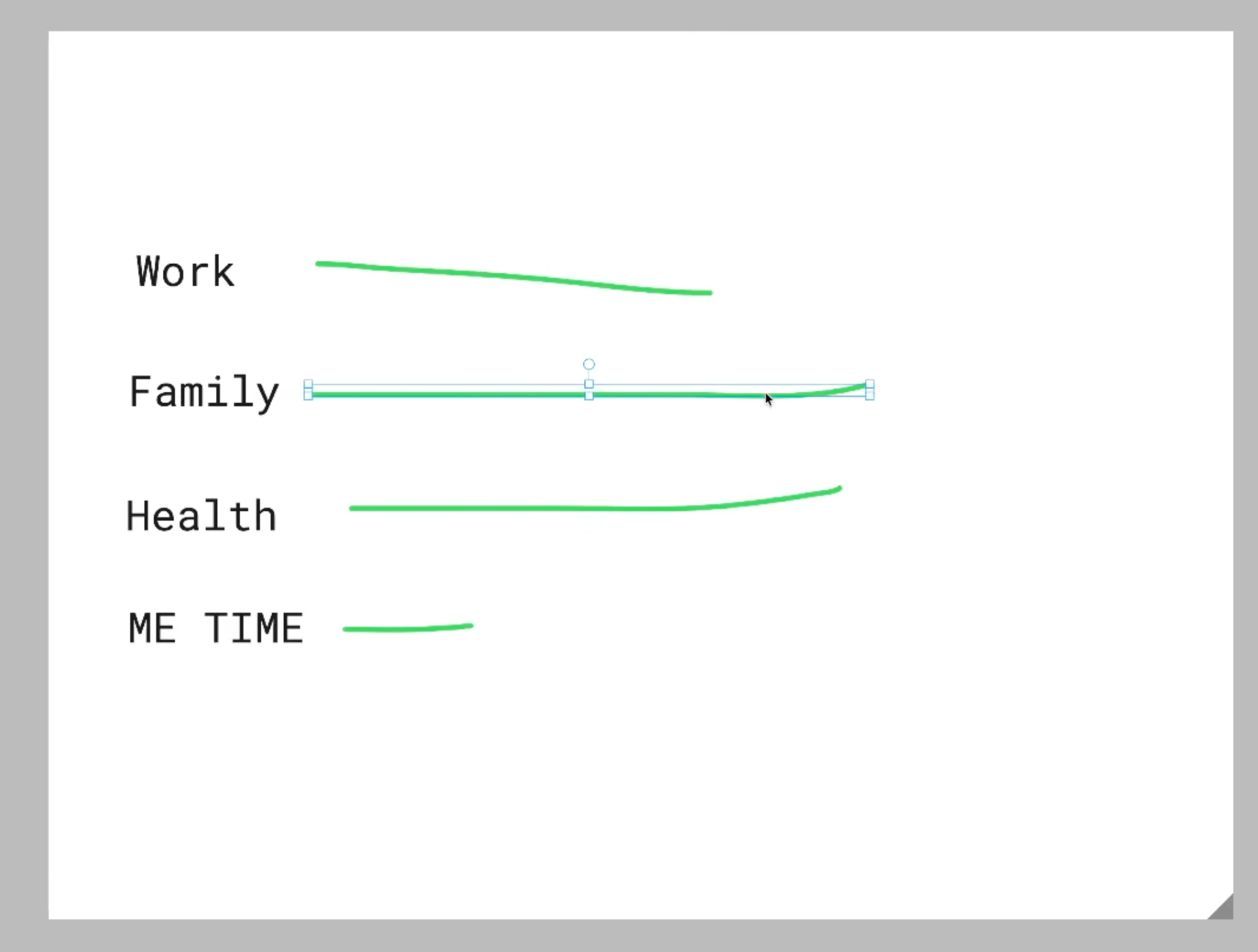
In the video I sketched out the 4 things that actually exist in an average week: work, family, health, and me time (creative projects, video games, relaxing). The imagined version of the week has all 4 balanced. The real version has one of them dominating, and everything else sitting somewhere between yellow and red, barely being touched. If you read that as a complete failure of being an entrepreneur or being an adult, that’s what creates a shit ton of the stress.
What I actually do now
I’m not going to pretend the transitions were easy, or that I always know exactly where I am. But I’m just not obsessed with keeping all the metrics green all the time, and in this season the priority order is settled: if there’s any issue, any problem, anything that needs doing, family dominates. After that, the first thing I allow to suffer is the structure of the work, the when and how of it. Then me time. Then health.
It’s not even consistent within a year. I work more in the winter and less in the summer, partly because I live in Europe and it’s so hot, partly because my daughter is off school for long stretches. So maybe this winter I push harder on the business, and this summer I put more effort into the health things. It doesn’t have to be every light green, all the time.
If you’re still in the building phase, if your main bet hasn’t paid off yet, some things are going to sit at red or yellow while you push, and some weeks the whole plan gets rewritten by 9am. Knowing which season you’re in, and deciding on purpose what’s allowed to suffer, is the whole thing.
Cheers,
Jonathan
P.S. The full video is up on YouTube, complete with my daughter in the background and a sketch made in the worst drawing app I’ve ever used. If you know one business owner who’s stressing themselves out trying to keep every light green, send them this.
P.P.S. About that drawing app: I was using Auto Draw and it’s very bad. If you know an easy online drawing tool, leave a comment at www.unscheduledceo.com, I read every one of them.
100% agree