


Hey,
As you might already know: I LOVE WEBINARS.
Webinars are the cornerstone marketing tool for all of my business and I’m ALWAYS trying to convince my entrepreneur friends to give them a try.
But then they ask me a lot of questions…
So i’ve decided to finally make a proper sort of “kick start” guide for anyone who’s either Webinar-Curious or already using them to generate revenue.
You can either read this article, watch the video or both
AND! You can copy/paste this entire guide into your AI tool and use it to help you design your own webinar!
Let’s go.
Why I keep banging on about webinars
One funnel in my facilitator.com business, ONE funnel, has made over €23 million since we launched it in 2020. At the center of that funnel is a webinar.
In my opinion, webinars are the most powerful marketing tool that exists. i haven’t found anything that can take a stranger from the internet and turn them into a customer more effectively and measurably than a webinar. That’s my personal opinion based on the last ten years of running them for myself, for collaborators and for friends.
And before you think this is just a “course guy” thing: Stanford Business School runs webinars. Basecamp runs webinars. SaaS companies run webinars. Daniel Priestley is running them all the time, he just calls them things like “Mid-Year Momentum.” People rarely call them webinars. They call them info sessions, workshops, free trainings. Same thing.
A webinar is just a live (or prerecorded) stream, usually around 90 minutes, where you demonstrate your product or service, and at the end you’re either getting call bookings or selling right there.
This matters most if you’re bootstrapped. If you’re VC funded you can spray money at ads and survive a bad conversion rate. If you’re a small business selling high ticket stuff, corporate deals, coaching, group programs, you need a relatively quick return on investment. What i love about a webinar is you get an answer VERY quickly as to whether your marketing is working or not.
Almost every webinar you’ve ever seen follows the same structure. Once you know it, you can mess with it and make it your own. Here it is.
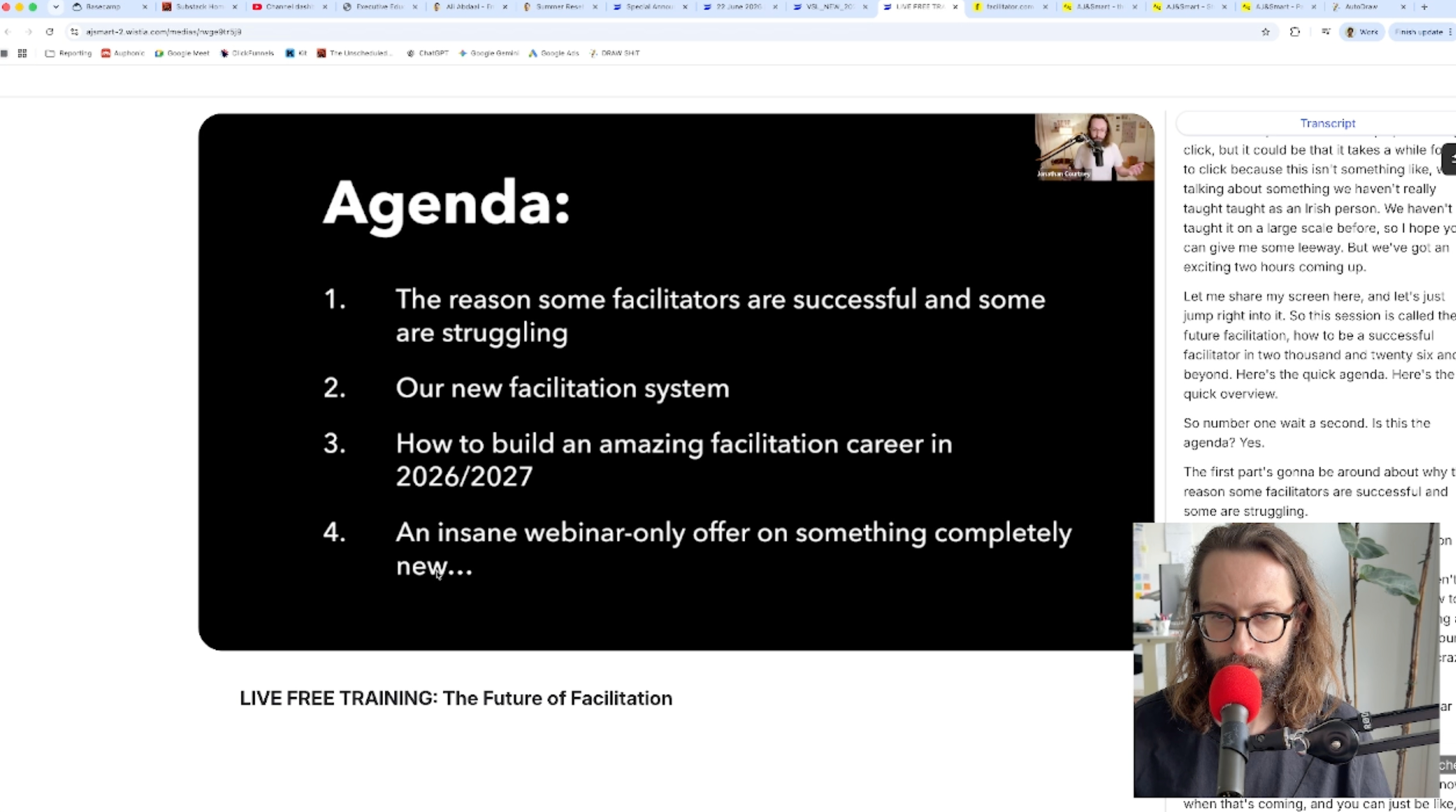
Part 1: The intro (agenda, housekeeping, trust)
The intro is three things.
Agenda. Here’s what’s coming up broadly, and there’s a live Q&A at the end.
Housekeeping. This is where most people mess up. Tell people RIGHT UP FRONT that you’re going to pitch them something. Most people don’t do this, and so the audience spends the whole webinar nervously waiting for the catch. i literally say: “towards the end of this we’re going to offer you a way to work with us, you’ll know when that’s coming.”
It sounds counterintuitive but it builds massive trust. People think “these guys are very open about selling,” and they relax.
A few more housekeeping things we always do:
We don’t send the recording afterwards. If you tell people a recording is coming, they leave the webinar immediately. So we say up front: this is a live thing, take notes.
We set behavior expectations. No posting your LinkedIn link in the chat. One person does it and suddenly you have 1000 LinkedIn links and the whole chat is useless.
And i set expectations about MY style. i tell people this is not a TEDx talk, i’m a messy, chaotic speaker, i swear. If people don’t like that, they can leave immediately and i don’t have to deal with them in the chat. Your webinar should match your vibe, not some glistening clean Tim Ferriss thing (unless that IS your vibe).
Trust. Very quickly: who you are, what you do, in a nutshell. Use whatever trust elements you have. For us it’s things like “we’ve trained over 35,000 people” and having the biggest YouTube channel in our niche. You don’t need numbers like that. You need SOMETHING that says “you can trust me on this topic.”
One line i always drop in here: everything i teach today, you can get for free on our YouTube channel. You never have to give us any money. i say this because i’m going to come back to it in the pitch later: “you can take all of our stuff for free, but here’s why you might want to pay us.”
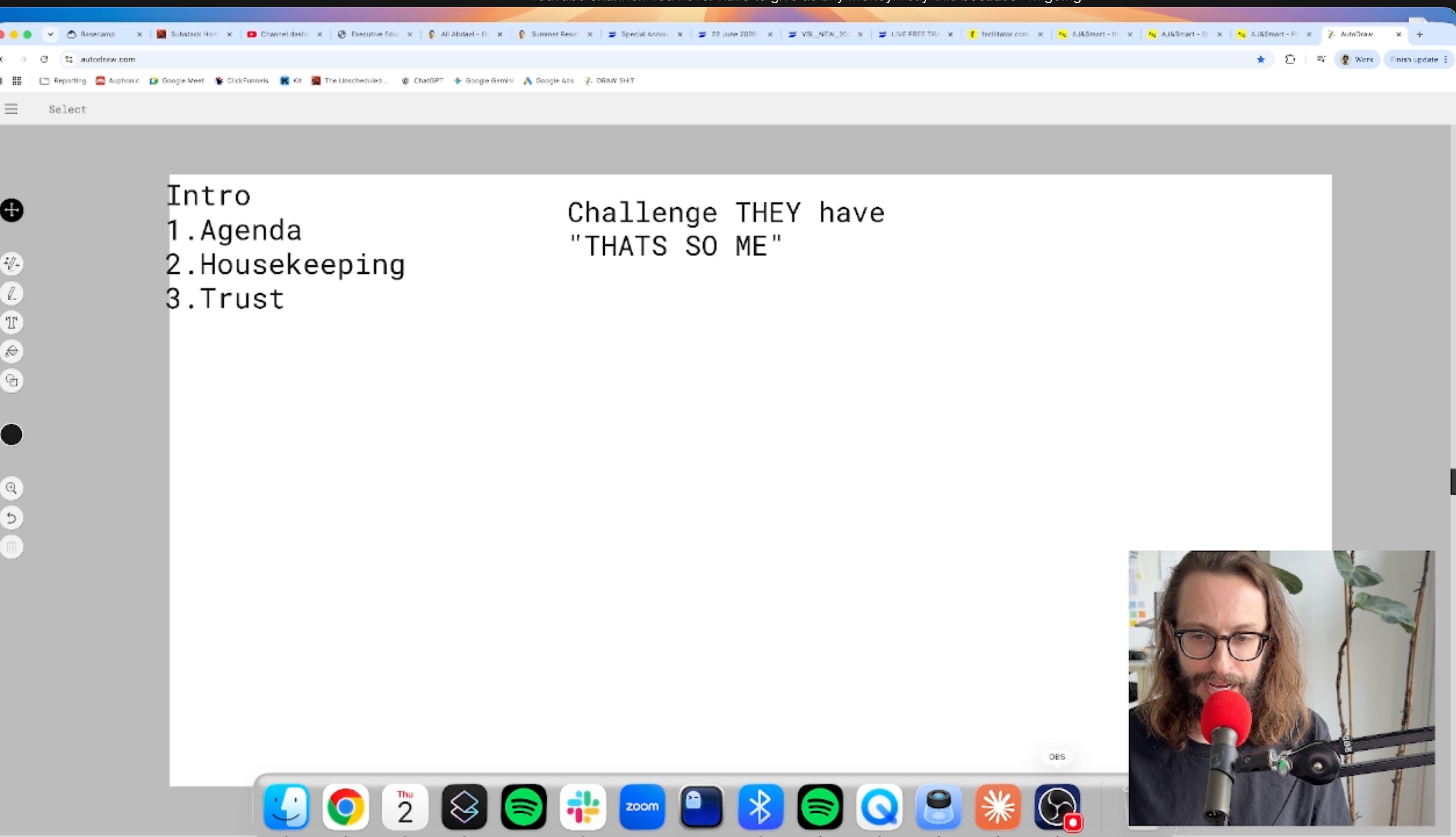
Part 2: The challenge (”that’s so me”)
The first 20 to 30 minutes after the intro is about ONE thing: articulating the problem your audience has better than they can articulate it themselves.
That’s it. That’s the whole job of this section.
If i’m doing a webinar teaching business owners how to get better with AI tools, i’m talking about how hard it is to keep up, how it feels like you’re being left behind, how your team is disappearing down rabbit holes that never turn into revenue. And i’m weaving my own story into it: me being completely confused about where to even start.
The reaction you’re fishing for in the chat is: “that’s so me.”
That’s the phrase. When people are typing “that’s me” and “that’s exactly my problem,” this section is working.
You back it up with news headlines, comments you’ve seen, statistics, clips from podcasts. And you’re constantly asking the audience: “how many of you guys feel that?” When the chat fills up with yeses, everyone else sees it and gets pulled in too.
This works for any business. Running a design agency selling to corporates? The problem is that in-house teams are trapped in day-to-day work and have no time for the next big thing, even though they’re being told to innovate. If you were Basecamp, you’d spend 20 minutes showing the chaos of juggling ten different tools with clients and teams out of sync.
Part 3: The vehicle (the solution, but NOT the product)
Now you tell them the solution you found. This is what the webinar world calls “the vehicle.”
Important: the solution is basically the thing you’re trying to sell, but WITHOUT the product name or the package yet.
Example from a webinar i ran in January. i told the story of being overwhelmed by AI tools, seeing everyone vibe coding while i understood nothing. Then i bumped into another CEO, Charles from Pip Decks, and he sat with me for three hours and showed me how he uses these tools. And it clicked. Months of confusion ended right there.
To be clean about it: the vehicle in that story is Claude Code. That’s the thing that actually solved it. The CEO was just who brought me to the solution. But here’s the important part: i’m not selling Claude Code. It’s not the product i’m pitching in that webinar. The vehicle is the thing you believe solves the challenge, and your product is how you help people get there.
If you’re Basecamp, the story is “we couldn’t find anything that worked so we built our own internal tool, and that solved it for us.” You’re not saying “and that tool is Basecamp, buy it now.” Not yet.
Part 4: The three secrets (destroying limiting beliefs)
This is the part everyone gets confused by, so let me make it simple.
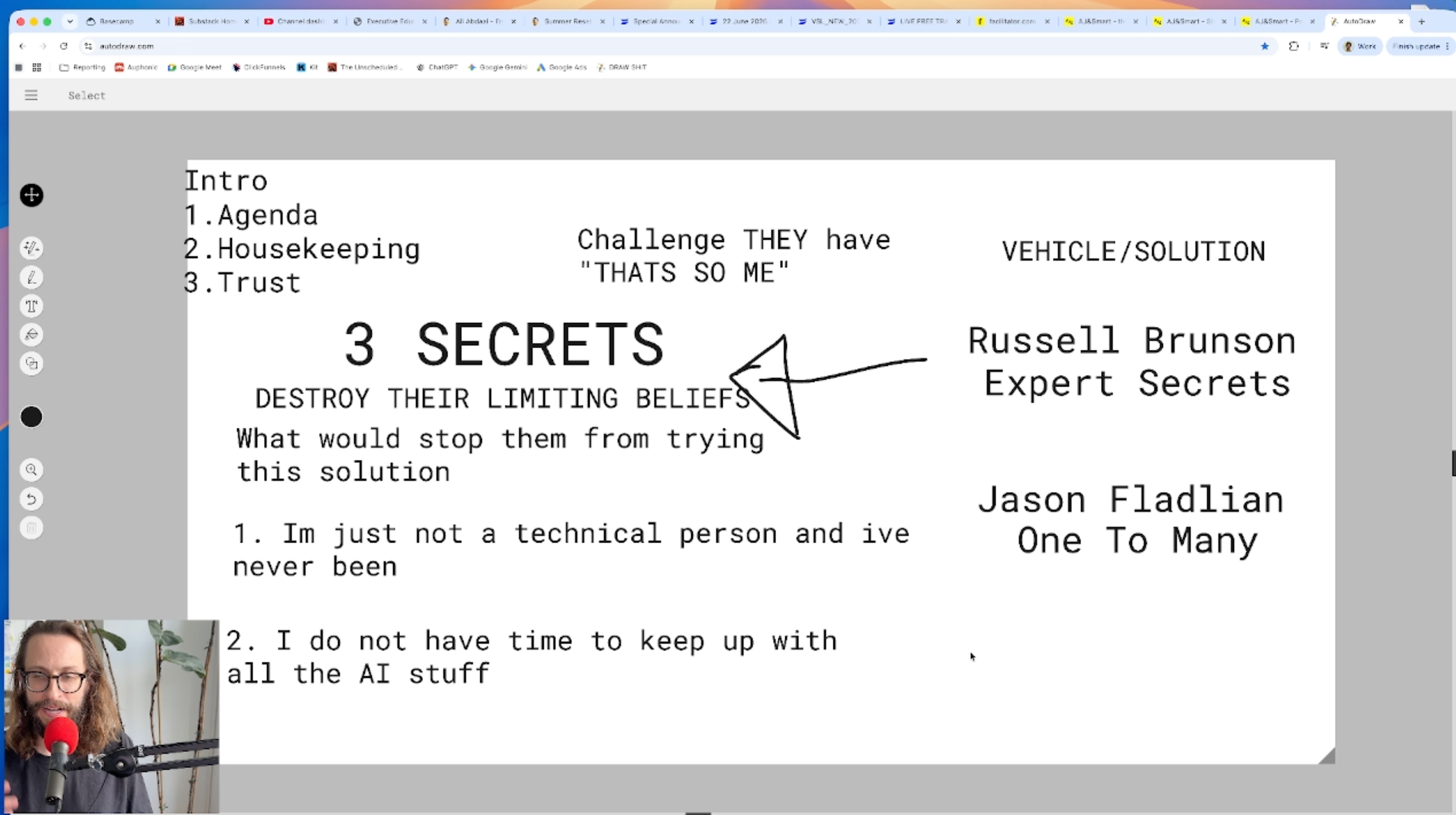
After you present the solution, your audience has objections forming in their heads. Beliefs about themselves or the world that would stop them from even trying the thing you’re suggesting. “The three secrets” (a concept i first learned from Russell Brunson) is just a structured way of destroying those beliefs before they harden.
Here’s the process. Take a whiteboard and write down everything they might be thinking that would stop them. For an AI training program aimed at founders, it’s things like:
“i’m just not a technical person, never have been.”
“i don’t have time to keep up with all this AI stuff.”
“this is something my tech person should do, not me.”
Then you flip each one into an empowering, actionable positive. “i’m not a technical person” becomes: if you know how to use Microsoft Word, you can use Claude Code. And then you do a whole section proving it.
Real example from our facilitation webinar, these were our three:
Why learning more exercises will never make you a better facilitator (and what actually will). Because our audience believes memorizing exercises is the path to being great.
Why the best facilitators in the world look like they’re doing nothing. Because we teach a style with fewer post-its and exercises, and people worry their clients will think they’re not doing anything.
The one facilitation skill AI will never replace. Because we KNOW everyone is sitting there thinking “isn’t AI going to replace this anyway?”
That last one is the point of the whole section: hit the objections before they get to them, so nobody sits through your entire webinar with a “yeah, but” stuck in their head.
Part 5: The two paths (the pitch)
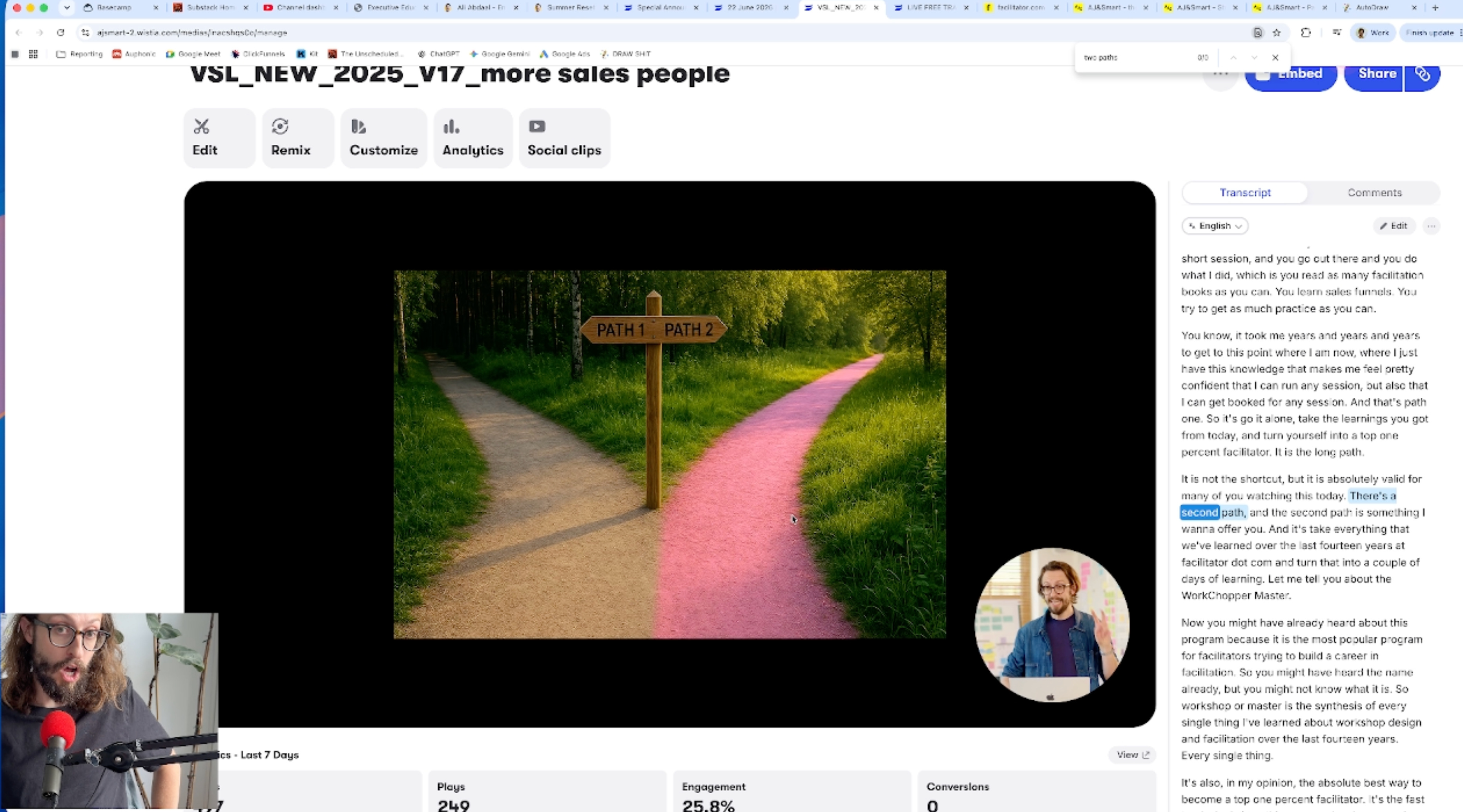
Now, and only now, do you pitch. And there’s a transition that makes it feel good instead of gross. i call it the two paths.
Path one: the long path. They take everything they learned today and do it themselves. Read the books, get the practice, spend the years. i tell them honestly: this is absolutely valid. It’s how i did it. Some people on the call will want this path. They’re not your customers, but offering it is what lets you transition cleanly to:
Path two: the shortcut. “For those of you who want this to happen sooner, who know you’ll forget about this the moment you close the tab, let me tell you about how we can help.”
And then you show the product.
Two ways to end it from here. Either a “buy now” where you send people straight to the purchase page with the bonuses, or a call booking, which is what we do for anything high ticket. As a rule of thumb, anything over about €2,000 should go through a discovery call first. i really like call booking webinars because you don’t have to do any hard selling at all. The pitch is literally “you can book a zero obligation call with my team to see if this is a fit.” Calm and easy.
Part 6: The Q&A (where the money hides)
This is not industry standard, but we’ve been testing it for a year and a half and i love it: stay on after the pitch. Sometimes for HOURS.
And here’s the move. During the Q&A i ask directly: “is anybody on the fence about booking a call or buying the thing? Ask me why you’re not buying. i want to either get you off the fence or make you a hell yes or a hell no.”
People love this. It’s honest, and it turns objections into content in real time.
In January i hosted a webinar for a partner company. Ninety minutes in we’d made €77,000 but the goal was €250,000. So i texted him: “this isn’t working, we need to stay on and do a longer demonstration.” We stayed on for 5.5 hours until we hit the goal.
Do this this week
Write your “that’s so me” list. Ten sentences describing your customer’s problem in THEIR words, better than they’d say it themselves. This becomes Part 2 of your webinar.
Write down the limiting beliefs. Everything your audience believes that would stop them from trying your solution. Pick the three biggest and flip each into an empowering statement. Those are your three secrets.
Draft your two paths. One honest paragraph on how someone could do it all themselves, and one on how you shorten it. That’s your pitch, and it doesn’t feel like one.
Pick your ending: buy now, or book a call. If it’s over about €2,000, it’s a call.
You don’t need a production studio. My €250,000 webinar was me in my home office on my Mac Studio’s built-in camera, at night, because our customers are in the US. It’s hard to get perfect, but it is NOT hard to get started.
Cheers,
Jonathan
P.S. i stole 90% of this from watching the masters. If you want to go deeper, read Expert Secrets by Russell Brunson (whatever you think of him, he’s incredible at this) and One to Many by Jason Fladlien, who writes webinars for people like Alex Hormozi. i have nothing to do with either of them. Just buy the books.
"Here's how I made millions, now you do it". Baller.
It is a great format. I actually am shaking things up at the saas company I work for. I am about to launch a new product and am 100% using the perfect webinar format in 2 weeks. Just finished my script yesterday and am really stoked!
I just can’t do the boring corporate product webinar after doing this in my own business