


This is the written version of this week’s bonus Youtube video. The video is the full, unedited, chaotic version. This is the good bits, organised by taking the transcript and having an AI tool (who’s name is Stinky) clean it up.
[Watch it on YouTube]
Oh HULLO!
I think what you’re going to learn here is going to be a bit mind blowing. Especially if you’ve ever thought of writing a non fiction/business book to grow your business.
In mMay 2025 I launched a book called Strategy Signal. It’s short, essentially a little booklet, and it took 6 weeks total to go from not existing at all, to being on sale, and as of yesterday it’s generated $1,600,000 revenue.
And btw I don’t mean that it “could have contributed to bringing in 1.6 million”, I mean that 1.6 million dollars are directly attributed to this book (i’ll show the number breakdown later in the article).
It’s also the less successful of the 2 books we launched in the last few years. The older one (The Workshopper Playbook) made somewhere between $3 and $5 million (I couldn’t actually get the accurate numbers for this one because the attribution has become blurry in the 6 years since launch).
People congratulate me when we launch one of these. “Congratulations on writing a book!” And that’s not what this is at all.
I get asked about this constantly. Should I write a book? Will it get me more clients? What’s even the point? Most people don’t really understand what a book is for in a business context, so this week I opened up the actual funnel software, the real Facebook ads, and the exact sales numbers behind the book funnels we run at Facilitator. If you run a business, especially a consulting or agency type business, this is exactly the kind of asset you could be using to bring strangers into your world. (Quick note if you’re new here: I’m Jonathan, I run AJ&Smart, a holding company with a bunch of businesses in it, the biggest one being Facilitator.)
The nuggets (if you only read one section, read this one)
A book funnel is a paid lead magnet, and the whole thing is built to generate ONE thing: a call booking. The book brings strangers in from Facebook ads, the upsells qualify them, and the qualified ones get offered a call with my team. For every 100 calls we get 18 to 21 sales, and the thing we’re selling is a $14,000 in-person training. That’s what the $6.99 book is feeding.
People take a book more seriously than a PDF. We have normal downloadable lead magnets too, and the book funnel beats them every time. Nobody wants to hear me talk about a little PDF, but people do want to hear me talk about a book, even if the final product is still a PDF. It sounds stupid, it sounds weird, but people just like books.
The front end money is the least important part. Strategy Signal made around $400,000 up front, and only about 20% of that was profit, because we pump it all back into the Facebook ads machine. The back end made $1.2 million. 1 in 6 people who bought the book came back and bought something else from us. For every $1 the book made, we made $6.80 in sales.
We charge $6.99 on purpose, and it has nothing to do with the money. Reason 1: I saw someone else’s book funnel charging $6.99 and copied it. That’s the honest truth. Reason 2: it’s a small barrier. If someone is going to question spending $7, they were never going to pay $14,000 for a training, and we don’t need them on the list.
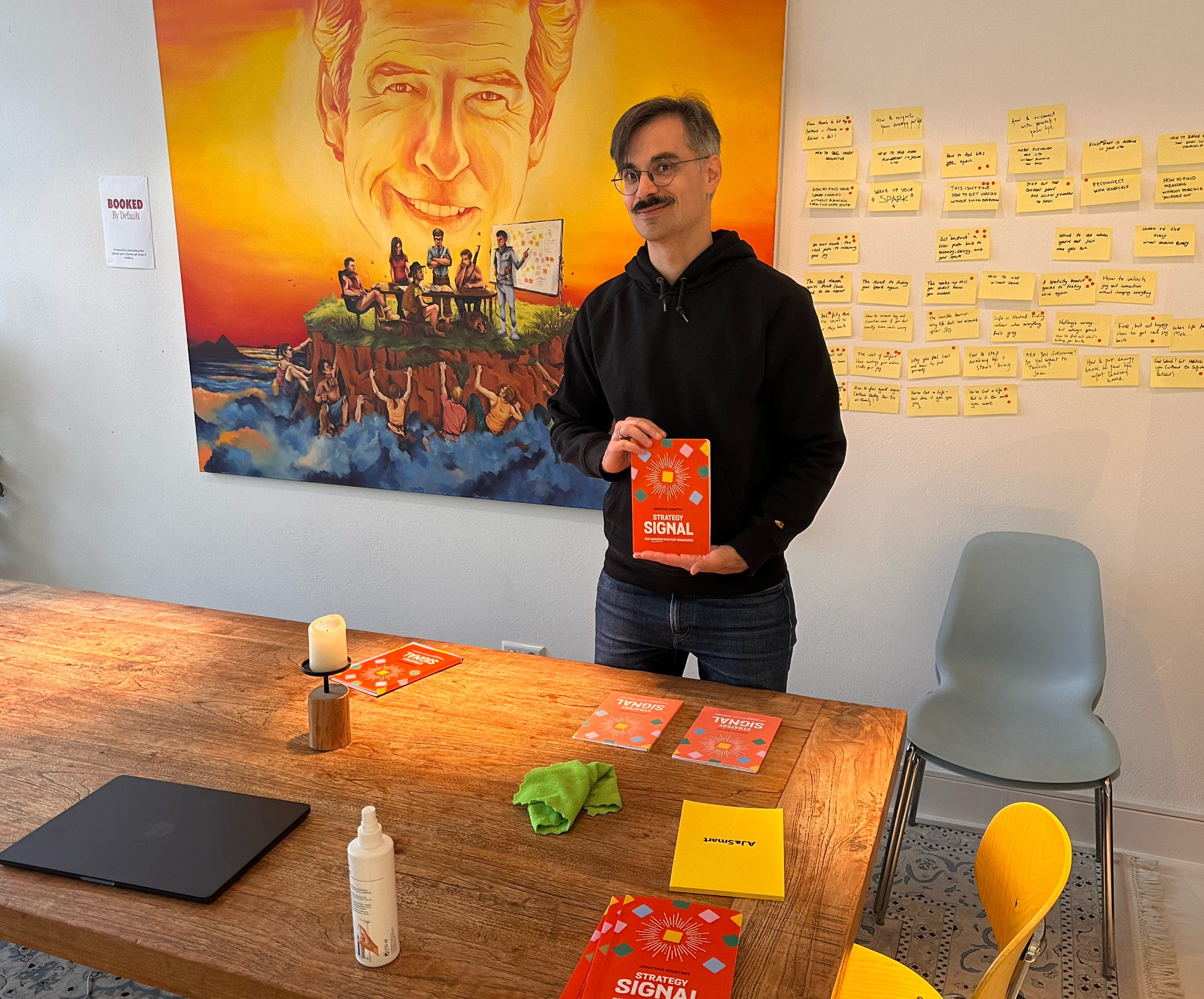
Launch to your warm audience first, cold 2 weeks later. The warm launch gets the physical copies, feels like an event, and made around $70,000 on its own. It also gets us photos of real people holding the book, which go straight into the cold ads. The cold launch is silent. No one even hears the cold launch.
Writing the book is the easiest part of the entire process. The hook, the angle, the upsells, the funnel itself: that’s the hard part. But the writing is where most people get stuck. Strategy Signal was mostly content that already existed inside one of our training programmes.
These funnels run hot for 6 to 12 months, then trickle. Strategy Signal had really good ad numbers for about 6 months, was fine for another 6, and then the diminishing returns kicked in. Now it sits in evergreen mode in the background, generating some call bookings but not a lot.
Okay. The story.
The colour came before the book
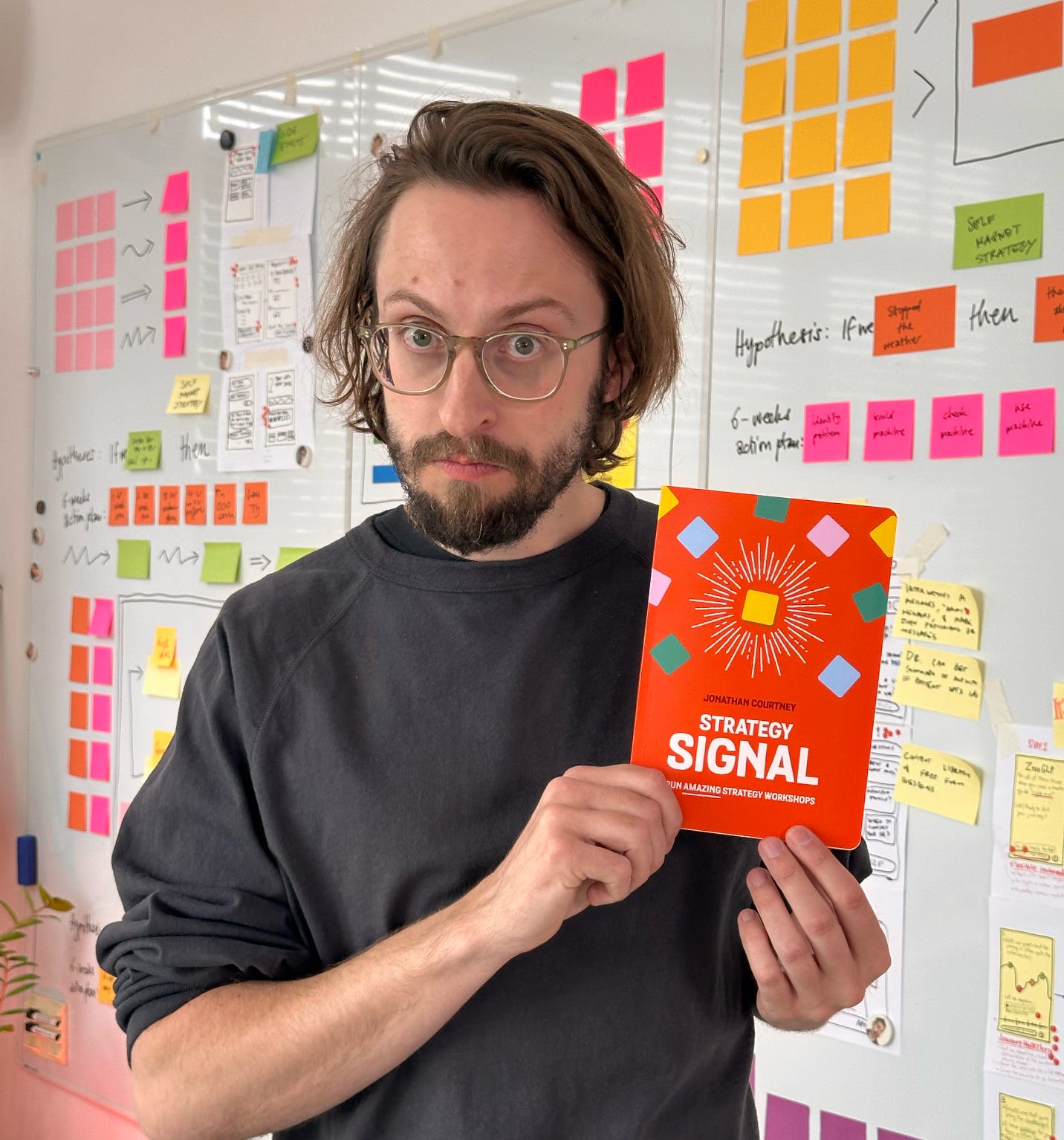
The moment Strategy Signal started was me sitting in a restaurant with my fiancée, looking at the table, which was this exact red colour. We were like, this would look really good in Facebook ads, this colour is going to stand out. So BEFORE we had the name of the book, before we even had the topic of the book, we had the colour of the book. Just to give you a feeling for how funny and weird these things sometimes go.
For most of the project the book was just called How to Run a Strategy Workshop. Then, while I was in San Francisco, I called Tim, our designer, and we changed the name to Strategy Signal, because How to Run a Strategy Workshop felt like a throwaway thing and Strategy Signal felt more serious.

What a book funnel actually is
Most people think about books the traditional way. You spend months writing it, you get a publisher, you release it, you go around trying to sell it, and if it all goes well you become the authority on a topic and corporates book you for speaking gigs. That process takes around 2 to 3 years from start to finish.
A book funnel is something very different. You’re rarely creating a full length book that you’d see on shelves. You’re creating a small asset, a pamphlet, that works as an entry point into your world. If you understand lead magnets, this is essentially a paid lead magnet.
In the funnel business this is called a self liquidating funnel. You pay for Facebook ads on the front end, people spend money inside the funnel, and the funnel pays for the ads. Let’s say the ads cost $30K per month but the funnel is making $50K per month. Well, then you can just keep spending more money on ads. The people who don’t book calls go into a sort of holding pattern newsletter and other campaigns, and we keep trying to bring them back towards a call from there.
And the reason it beats a normal lead magnet: people take it much more seriously. If I’m holding a book in an ad, people get it instantly. It’s a book, I’m going to buy a book. It also lets us do much more interesting marketing and turn the whole launch into an event. Nobody wants to hear me talk about a little PDF.
Where the book fits in the universe
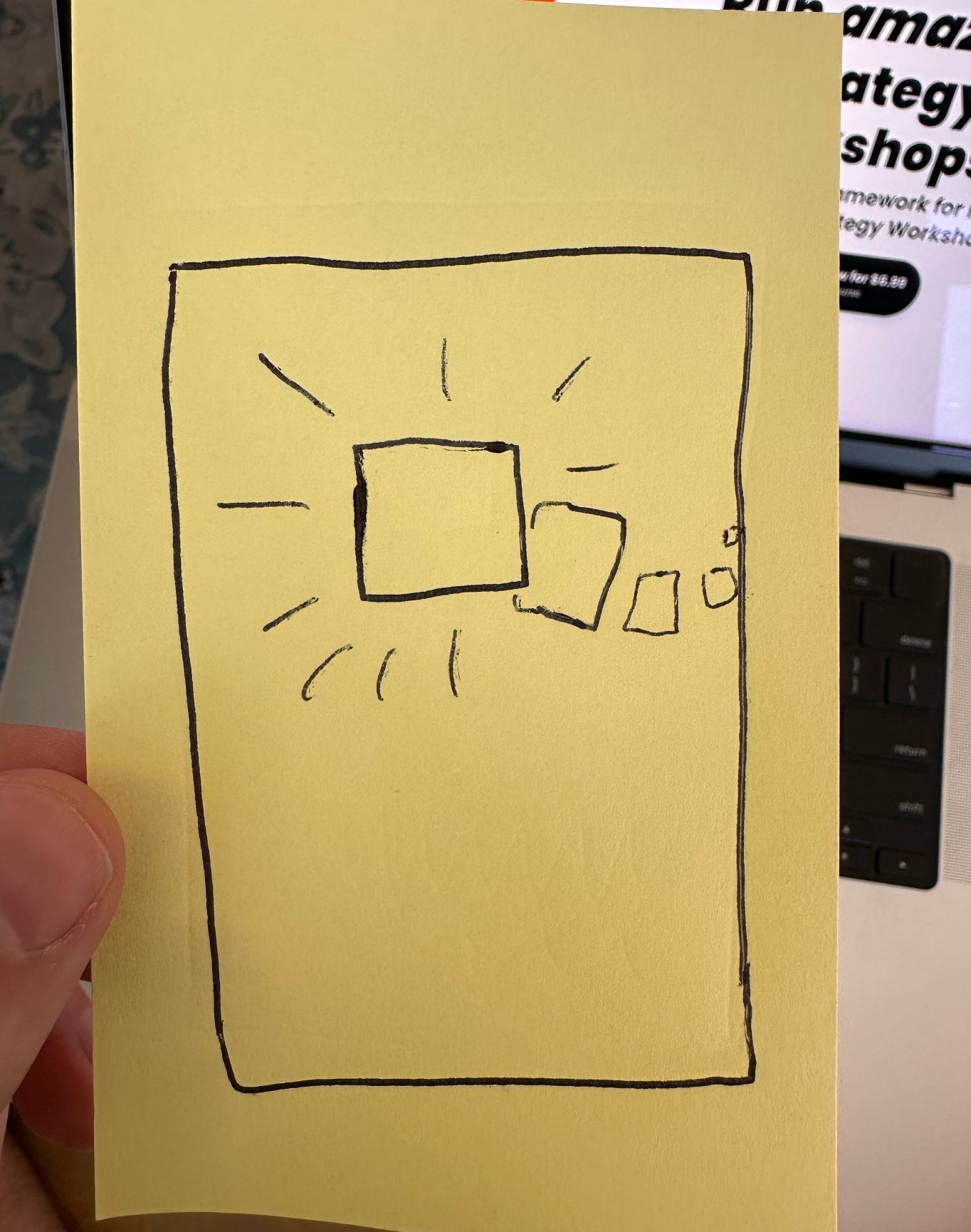
The way we pick topics: draw your funnel. At the bottom is the thing you actually sell. For Facilitator that’s facilitation, and specifically things like Full Stack Facilitator, our in-person training that costs $14,000. Then you ask, what’s the step just before someone realises facilitation is the solution to their problem? For us that’s workshops, design thinking, Business Model Canvas. And a level above that sits the broadest problem of all, which is basically meetings and collaboration.
Strategy Signal deliberately enters at the workshops level. We targeted consultants who kind of already understand the aesthetic of workshops, who know about design thinking and all the innovation stuff, but don’t know that the underlying core of it all is something called facilitation. The word strategy clicks for them. The book’s only job is to move them one step down the funnel.
(We also have an unreleased book that’s just called Meetings, aimed at the very top of the funnel. It’s more like a zine. I still want to launch it one day.)
This works for any business. In the video I sketched the same drawing for an AI consulting business. At the bottom is what you sell, AI automations, done for you client work. A step before that, the business owner is messing around with ChatGPT and agents, chaotically. So your book is probably something like Your First AI Employee, a booklet that shows them what’s possible, and at the end of it, they can book a call with you.
The launch (and the disgusting rag)
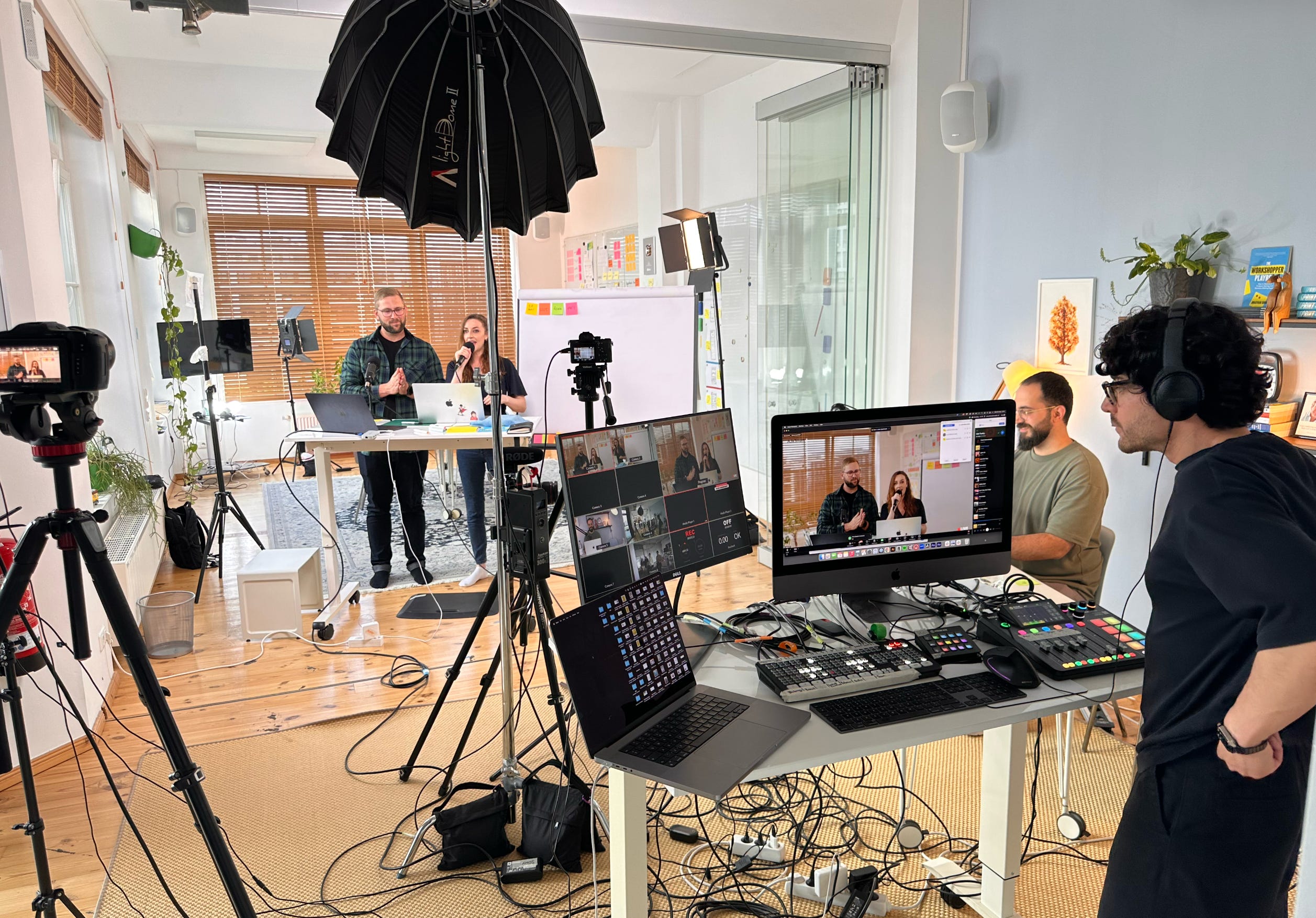
We always launch to the warm audience first. Our list size is approximately 125,000, and whenever we build a new cold campaign, the warm audience gets it first as a completely separate campaign. Hardly anyone does this, and it was even hard to explain to the internal AJ&Smart team, but the warm launch is where the physical copies go, and it made around $70,000 on its own.
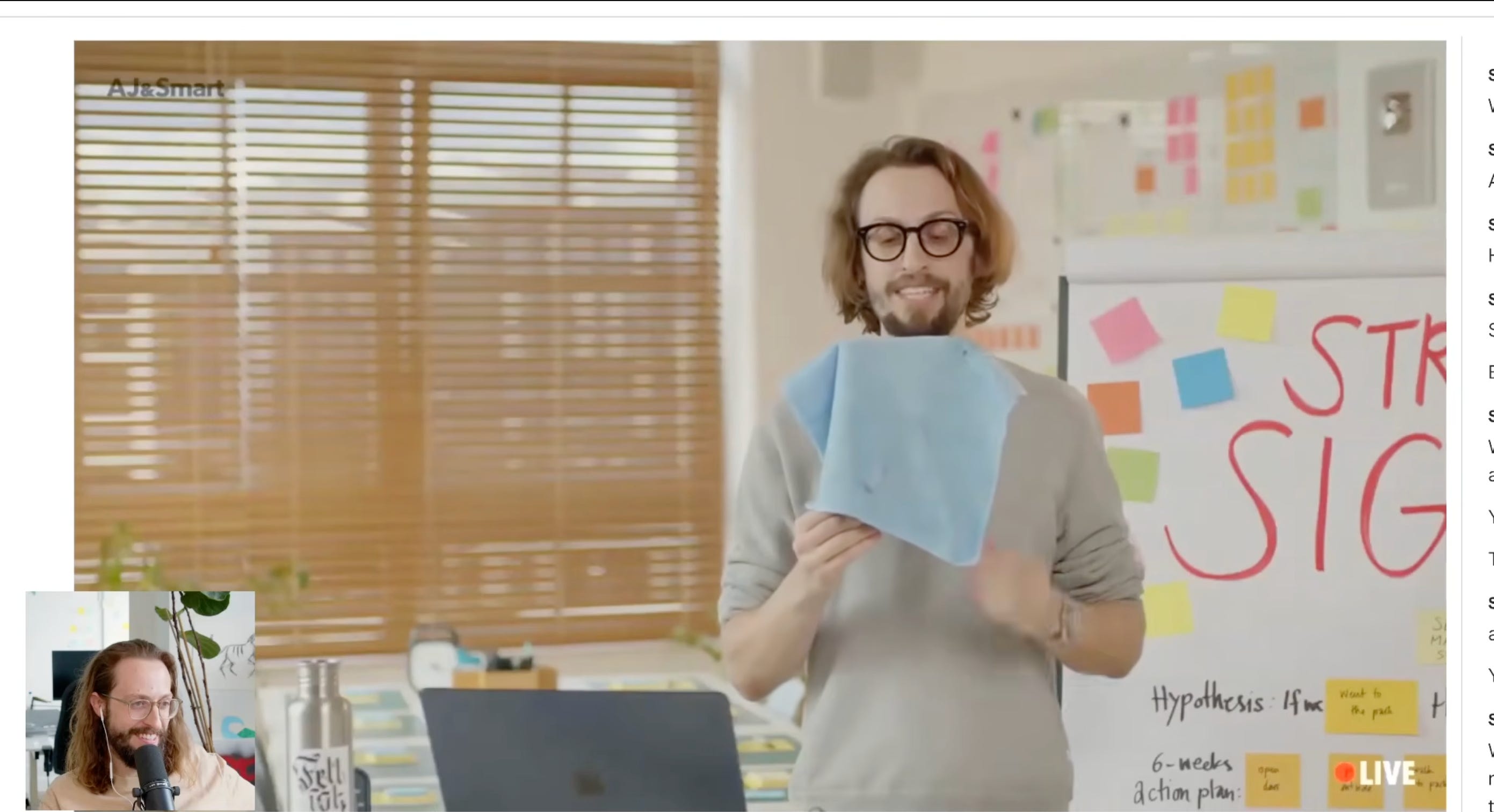
The launch itself was a webinar, about an hour and 25 minutes, where the book sat covered on the table until the reveal. My actual words: “I’m going to remove this very disgusting rag.” Then the announcement, then me leaving a silence for everybody clapping.
Why physical copies at all, when the cold funnel is digital only? Because we want pictures of people holding the book. That’s it. Those photos go into the ads and onto the landing page, and the whole thing becomes more and more trustworthy. I think we printed probably 10,000 physical editions of the Workshopper Playbook and 5,000 or so of Strategy Signal. Print stuff out and show your stuff. Especially now, with all the AI stuff making everything feel kind of not very real, you know what I mean. People really like to have physical things. (The physical copy I was holding in the earliest ads had a totally different book inside it, because the real one wasn’t printed yet.)
Then, around 2 weeks later, we turn on the Facebook ads and start pumping people through until it reaches diminishing returns. The ads themselves are simple. We make a lot of silly ones too, but as Eli pointed out while we were recording, the ads that always work best follow the same shape: the first image is always the book, then some movement, this is Strategy Signal, this is what it teaches you. One of them opens with me offering to change your consulting career “for the price of a very expensive cup of coffee” (the funny thing is, that’s not even expensive anymore).
Inside the funnel: an opt in page, a first upsell, a second upsell, and if someone buys the right things, they unlock the call booking page. The upsells do a double job. They generate the money that keeps the ads running, and they qualify people, because only people who buy certain upsells even see the call booking. (These days the team didn’t want call bookings from this funnel anymore, so it leads to a video training instead, and the call booking sits at the end of that.)
On the call booking page there’s a video of me explaining that half my month is spent running strategy and growth sessions for really interesting companies all around the world. So this person who randomly bought a $7 book off Facebook 10 minutes ago is watching that and going, oh shit, these guys are the real deal. That’s the drip feed: you’re feeding information about your company to someone who had never heard of you, and by the end of it they’re booking a 20 minute call with my team.
The actual numbers
Strategy Signal, front end: around $405,000. Around 19,000 people opted in, around 8,423 people bought the actual $6.99 book, and the average cart per customer was almost $50, because the upsells are doing the double job I described above. Roughly 20% of the front end was profit, and the rest went straight back into the ads.
The back end, meaning everything those buyers went on to purchase from us afterwards: $1.2 million. So this one book funnel generated $1.6 million in revenue. That’s revenue, not profit. I can only give you the profit margin of the overall business during that period, because this was basically the only core funnel we were running at the time, and it was around 47%.
The older book, the Workshopper Playbook, did even better. We put a lot more time and ad spend into it, back when the return on Facebook ads was just so much better, and I don’t know the exact numbers on it anymore. My guess on camera was somewhere between $3 and $5 million.
So people ask, why wouldn’t you just keep doing these? Well, a book funnel is one of the most complicated funnel types you can build. My name is on it, and because I’m a designer I get obsessed with making sure it looks good. It took 6 weeks from “hey, we’re going to do a book funnel” to launch, which doesn’t sound long, but it’s a lot of work, and it distracts me from other things. Like, right now I’m trying to grow this Unscheduled CEO thing.
How I’d write one today
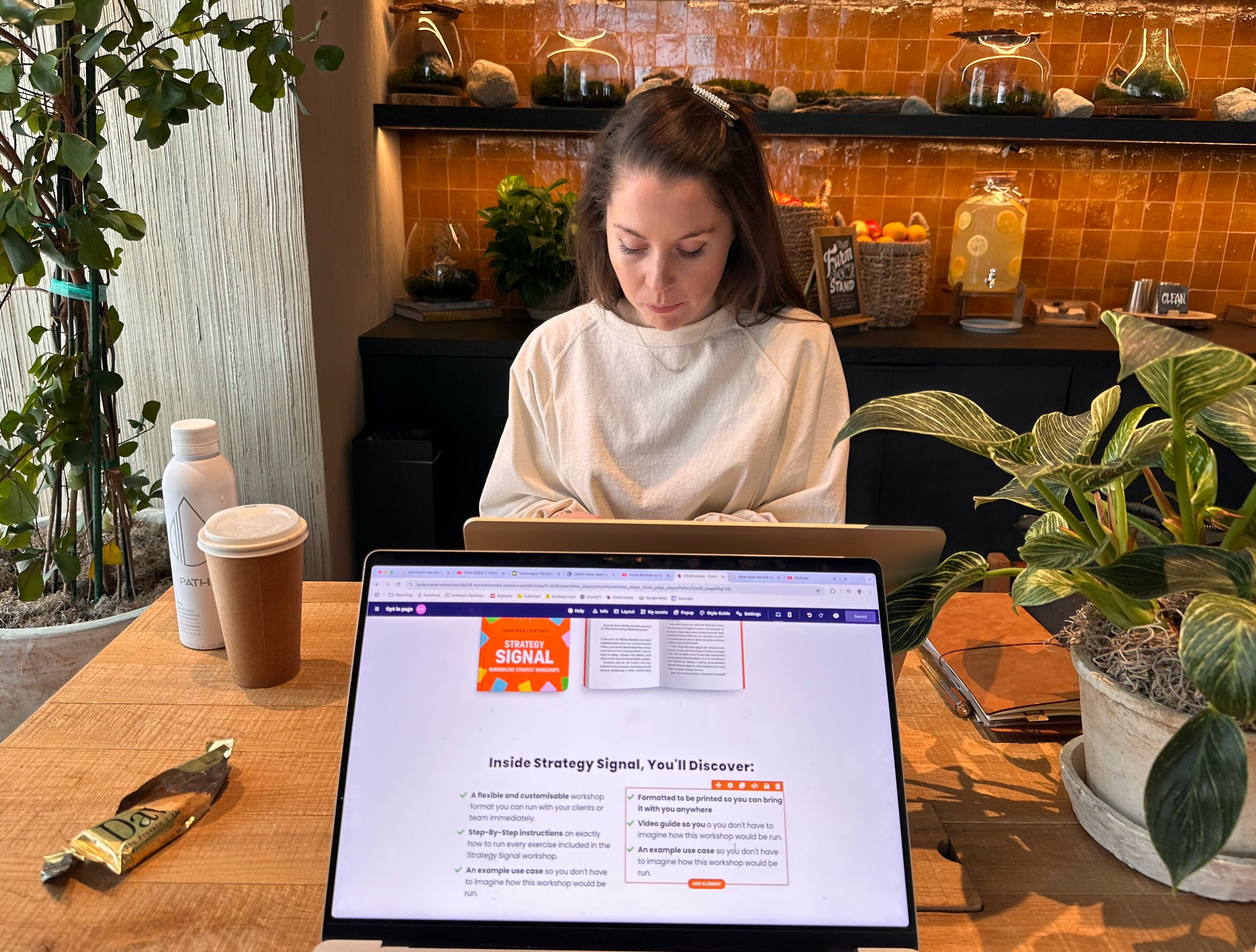
Here’s the part everyone gets backwards. Writing the book is the easiest, easiest part of the whole entire process. Coming up with the hook, the angle, the upsells: that’s the harder thing. But the writing is where most people get stuck.
The Workshopper Playbook had no AI involved, because there was no AI around when I wrote it. I spoke the entire book out, stream of consciousness. We used Descript to turn that into a transcript. Someone from Fiverr structured it into chapters in a Google doc. Laura went through the entire thing and essentially rewrote it. Then I did the final pass. So I never did the first written pass, I did the first verbal pass.
Strategy Signal was even easier, because the content already existed inside one of our training programmes. I’d already said all the words. Me, Laura and my sister Rebecca took the transcript, wrote a story into the beginning, and broke it down into a step by step guide on how to run a specific type of workshop. Tim then made it into an actual book.
If I was writing one today, step 1 would still be speaking it all out. The video this article comes from could itself be turned into a book funnel on how to make book funnels (I’m not going to do that, but you easily could). Then I’d use an AI tool, something like Wispr Flow, to take the stream of consciousness and clean it up so it’s actually readable. And then I would personally go through and manually edit it, to make sure it actually sounds like me and says what I want to get across. That last step matters, because it’s really hard to make AI writing compelling on its own. But remember, you’re making a booklet here, a guide. You don’t have to write a lot.
And yes, this is exactly the workflow behind what you’re reading right now. I take the transcript of me talking, have Claude break it down into an article, and then I rewrite the intro myself, because somehow the intro is never getting my vibe.
If you’re thinking about doing one
Start with the funnel drawing. Work out what you actually sell, then work out the step just before it, and make your book there. And remember that you’re not trying to make money from the book. Strategy Signal made money, but on the scale of AJ&Smart that’s not what we were focussed on. You’re trying to generate calls with the right people, people who would never have heard of you otherwise, and a book gives you an asset you can hold up and point at: this is the book.
The writing part that’s been scaring you off is the easiest part of the whole process. Speak it out loud this week, get the transcript cleaned up, edit it until it sounds like you. Almost none of the work is writing.
Cheers,
Jonathan
P.S. Want help launching a book, or even coming up with what it could be in the first place? Well if you’ve already got a large email list (over 10k) OR your business is currently making over $500k revenue per year then head over to AJ&Smart Partners and get in touch!
Or maybe you know someone who’s got a large following and might find this interesting? Connect us, and if they book, we’ll give you a 10% finders fee (of a pretty large number).
The man promised, "mind-blowing." The man delivered mind-blowing. Thank you for sharing this.
So if my high-ticket offer is $1k and not $14k, is it worth it to write that book?