


Hey,
Random Thursday email/video for you about something I wasted WAYYYY too much time trying to figure out.
How do you figure out what to pay yourself as an entrepreneur, as a business owner, and how much do you leave in the business?
This confused the shit out of me for the first 10 years of running AJ&Smart, and I probably lost ludicrous amounts of money doing it wrong. I don’t even want to think about it. It’s painful.
So let me try to simplify it for you, because I really wish someone had simplified it for me. (I’ll put the video here for those of you who just want to watch or listen):
Quick note before I start: I’m talking here about when you actually have a business with its own bank account. In America that’s an LLC, in Germany it’s a GmbH, you can also do this as a GBR. If you have a very big business, you already know the answer to this. If you’re just doing freelance work, you maybe don’t need this. This is for people running a small business with a few people in it.
There are two camps
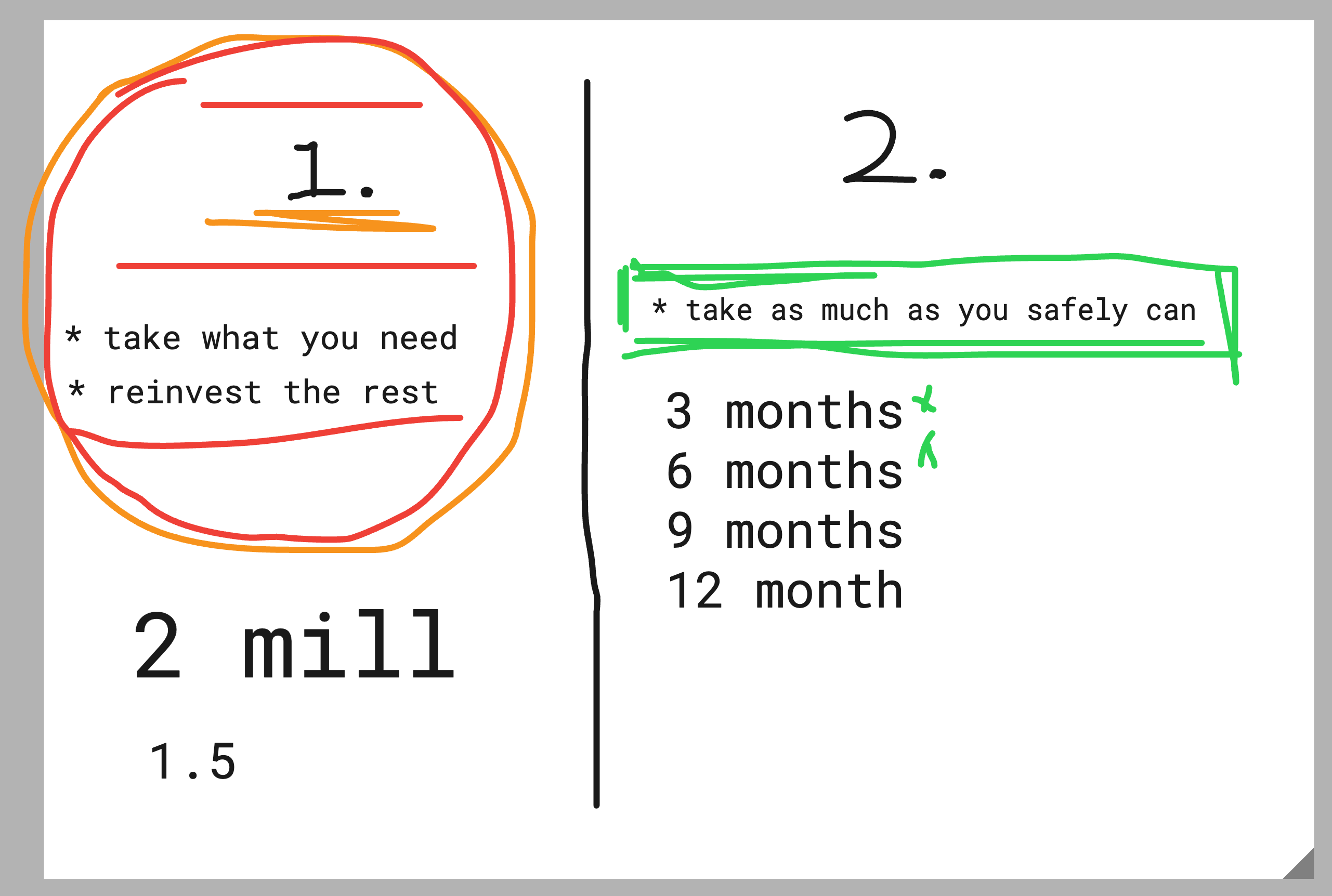
When it comes to paying yourself in a small business, there are basically two camps.
Camp 1: Take what you need, reinvest the rest
This is the one you’ll find when you search online. It’s the one mentors tell you. Look at your personal expenses, make that your salary, and leave the rest in the company bank account.
Why would you leave it in the business? Safety. Growth. Whatever it is. People in this camp will tell you the only way to grow is to keep reinvesting the profits and take the minimum you can take. They’ll also tell you it’s better for taxes, because you don’t personally get taxed until the money moves from the company account to your account.
Camp 2: Take as much as you safely can
This one says: look at the profits, and take as much as you safely can.
What does “safely” mean? Everyone has their own level. Usually you’re looking at how much cash is in the company bank, as in, how long could this company survive if we stopped making money today or had a couple of bad months. Some founders leave three months of cash in the bank. Some say six. Some say twelve. It’s based on your risk tolerance and how predictable you believe your business is.
I’m somewhere in between. I usually sit around nine months. Right now I think we’ve got twelve, but sometimes that’s just because I forgot to think about it.
So at the end of the year in this camp, you’re going: okay, we made a million, 400k of that was profit, I’ve taken a small salary that covers my baseline expenses, now how much of that 400 can I take while still keeping however many months of cash I want in the bank?
What I was doing (and why it was wrong)
Because most people were telling me to, I was doing Camp 1. And it seemed logical. The business is my investment. The asset is my investment. Taking the money out just makes the asset more risky, and I’ll get taxed the second I take it out anyway. Right?
What I did not think about were the negative side effects of Camp 1, which were pretty severe.
What Chris Do told me
A while back, when we were around 30 to 35 people and mostly a UX design and Design Sprint agency, Chris Do was hanging out in the Berlin office. (If you don’t know Chris Do, look him up, he’s an Emmy award winning designer and a legend.)
I told him I wasn’t feeling it. Not enjoying it, not really motivated to keep going. He asked how much I was paying myself. I told him: a minimum salary, basically what I needed for my expenses, plus a little at the end of the year. The number was roughly in line with a standard UX design employee at my own company. A bit more, but relatively in line with what I’d get paid as a UX designer somewhere else.
And he said, well, that’s your problem.
As the business owner, you have all the risk. Your employees have none. If you have a bad month, you don’t take a salary. If the company goes bad, you’re on the line for everything. I had the maximum risk and I was taking basically the same reward as everyone else in the company.
So I wasn’t seeing any tangible reward for growing the business. Yes, I had access to the money in the AJ&Smart account, but it wasn’t really mine. I knew that a couple of bad months and it’s all gone, eaten up by the business. My money was directly tied to every risk the business had.
His point: you need to feel the effects of this money on your personal life. If your life is exactly the same, if you’re still being super careful with money even though the business is making four million, something is off. I kept thinking “why don’t I just get a normal job?” That’s the problem when you’re not paying yourself in line with the risk and effort you’re taking. You get disconnected from the whole point of why you started, which was to build a business, work for yourself, and have your own thing.
Part of the issue was that I was getting advice from people who thought of us like a startup, not a bootstrapped small business. There was no investment in AJ&Smart. We started getting clients and grew from zero. There’s no real exit either. Sure, I could sell, but the deals are always kind of shit. So by not taking the money, I was just getting more and more disconnected from the point.
What Jason Fried told me
Jason Fried runs 37signals (Basecamp), so I won’t introduce him. Years ago he told me the same thing, more bluntly: it’s a terrible idea to leave the money in the company. Take it out, always. No one ever went broke taking a profit.
Here’s roughly what he said:
Unlike companies that reinvest all or most of the money back in every year, 37signals takes the profit out each year as distributions to the owners. This means every year they take risk out of the company. Companies that keep reinvesting keep adding risk. And when the company ends one day, as they all do, they’ll have enjoyed the upside as it went, instead of waiting for an outcome that might never come. They work to enjoy the now that’s guaranteed, not the future that isn’t.
You don’t hear people say this, especially because so much of our business advice comes from Silicon Valley and books written by people trying to build something massive. In that case it does make sense to reinvest and take investment. But if you’re a one-person show or a three-person show, you’re just creating a shit ton of risk for yourself.
He’s got an article called “Why we choose profit,” and the line that stuck with me: profit is the ultimate shield against bullshit. On the company level, if you’re actually profitable and not just burning cash, you don’t have to work on projects you hate or with people who suck. It gives you options. On the personal level, if the company’s burning you out and you’ve been taking the profits along the way, you have more options to walk away and do something else. If you stay on Camp 1, waiting for some imaginary day when you finally take the money out, you often never get there.
The zombie business problem
Think about it simply. Say you’ve got 2 million in the company account and your yearly costs are 1.5. You have a bad year, you get sick, COVID happens, the market shifts, and that year you’re not profitable. All that saving you’ve been doing is now essentially gone.
Here’s the trap: the company keeps going. So you get a false sense that things are working and will be fine, because you’ve got so much cash in reserve. But it might actually be a signal that the business is dead. You’ve got a zombie business. You see this with startups sitting on leftover investor money that just can’t die.
At AJ&Smart, our UX design work became a bit of a zombie business, because there was so much cash in the machine that I didn’t notice for a long time that it wasn’t really working. We could run months and months in the minus and it was all fine.
Cash also makes you do stupid things. A couple of years ago we had something like 18 months of cash flow, because I hadn’t taken it out (I need to reinvest, I need to reinvest). Someone came in and said let’s invest some of what’s left over into building something. I said cool, let’s do it. It dragged on for a year and a half, didn’t really work, and at least a million euro that’s no longer there. I could have taken some of that as a distribution and started the Unscheduled CEO thing sooner, with less pressure on us to do well.
The risk-reward thing
People will tell you that you should distribute profits to every single person in the company. Sure, if they also have the same risk. Meaning, if they also don’t get paid when the company isn’t making money, if they have to use their own money to keep it afloat, if they have to go to court if bankruptcy hits, like you do as the CEO.
The owner takes more money not because they’re an egotistical maniac. It’s the risk-reward thing. If I worked for someone else, my risk is low. They can fire me, but I can get another job. I don’t have to spend the next year or two shutting down a business, dealing with lawyers, and paying back the tax authorities. When a business fails, the amount of years that can drag on for is a lot.
So what should you actually do?
This is my opinion, not fact, but it’s also the opinion of people way more successful and way smarter than me: take as much as you safely can.
There’s nuance. This doesn’t mean you ignore the future. If you know you want to hire someone for Facebook ads next year, keep that in the company. Plan for those things. But take the rest. Take as much as you can without creating danger for the business, and don’t feel bad about it. That’s what a small business is for.
And there’s a responsibility side too. If you’ve got a few people relying on you, you have to be responsible enough that if the company fails, it’s not from pure negligence.
But here’s the real reason this matters. Another thing Jason said: you’ve just gotta take money off the table. If you don’t, you start to resent your own business. You start thinking “what the hell am I doing this for when I could make the same money by myself?” And usually that feeling means your effort isn’t bearing fruit, your personal life isn’t improving, you’re not feeling financially secure, and the machine is just eating you up while you tell yourself one day it’ll work out.
The whole point of making money is so you can do more of what you want and make more things. I would never have been able to spend my Tuesdays (and now a couple of days a week) messing around on a weird little art-business project called The Unscheduled CEO if I hadn’t been taking profits along the way.
Do this this week
Go look at your numbers and answer two questions honestly:
How many months of cash do you actually need in the bank to feel safe? Pick a number (three, six, nine, twelve) based on how predictable your business really is.
Are you feeling the effects of your business in your personal life at all? If the business is doing fine but your life looks identical to when you were broke, you’re probably stuck in Camp 1.
Then take as much as you safely can, off the table, into your own account. Don’t feel bad about it.
Cheers,
Jonathan
I really liked this format. It felt like a sidequest that answered a specific question whereas your main show can be more free-flowing. Great mix of structure and spontaneity.
Thanks, Jonathan, love your articles as much as your podcast :)
Here is the article "Why We Choose Profit" by Jason Fried for anyone interested: https://37signals.com/why-we-choose-profit